365 Divided by 2: Understanding Integer and Decimal Division
Dividing 365 by 2 might seem simple, but it provides a great opportunity to understand the difference between integer and decimal division. This is a fundamental concept in mathematics, useful in everyday life, from sharing cookies to calculating averages. For more complex division examples, check out this helpful resource: advanced division techniques.
Imagine you have 365 days in a year and want to find half. There are two ways to approach this, leading to slightly different but equally valuable answers.
Integer Division: Whole Numbers and Remainders
Integer division focuses on finding the whole number result and any leftovers. Think of sharing 365 candies equally between two friends.
Step 1: Perform the Division
Divide 365 by 2: 365 ÷ 2 = 182 with a remainder of 1.
Step 2: Understand the Quotient and Remainder
- Quotient (182): This is the whole number result. Each friend gets 182 candies.
- Remainder (1): This is the leftover candy. One candy is left over.
We can express this as: 365 = (2 x 182) + 1. This shows two groups of 182, plus the remaining 1, add up to 365. Did you know that understanding remainders is crucial for various applications, like scheduling teams or arranging seating?
Decimal Division: Precise Answers with Decimals
Decimal division gives you a precise answer, including any fractional parts. Returning to our candy example, if you were measuring ingredients for a recipe using 365 grams, the fractional part would matter.
Step 1: Use a Calculator (or Long Division)
365 ÷ 2 = 182.5
Step 2: Interpret the Result
The result, 182.5, means each friend would get 182 and a half candies.
Real-World Applications: When to Use Which Method?
Choosing between integer and decimal division depends on the context.
- Integer Division: Ideal for scenarios where fractions don't make sense, such as splitting toys between friends or assigning tasks. The remainder indicates items or tasks left over.
- Decimal Division: Perfect for precise measurements, averages, or any situation requiring a fraction of a whole number. For example, calculating the average temperature or your grade point average (GPA) often requires fractional parts.
Key Differences Summarized:
- Integer Division: Provides whole-number quotient and remainder. Useful when dealing with indivisible items.
- Decimal Division: Provides a precise, often decimal, answer including any fractional component. Ideal for measurement and averaging.
How to Calculate 365 Divided by 2: A Step-by-Step Guide
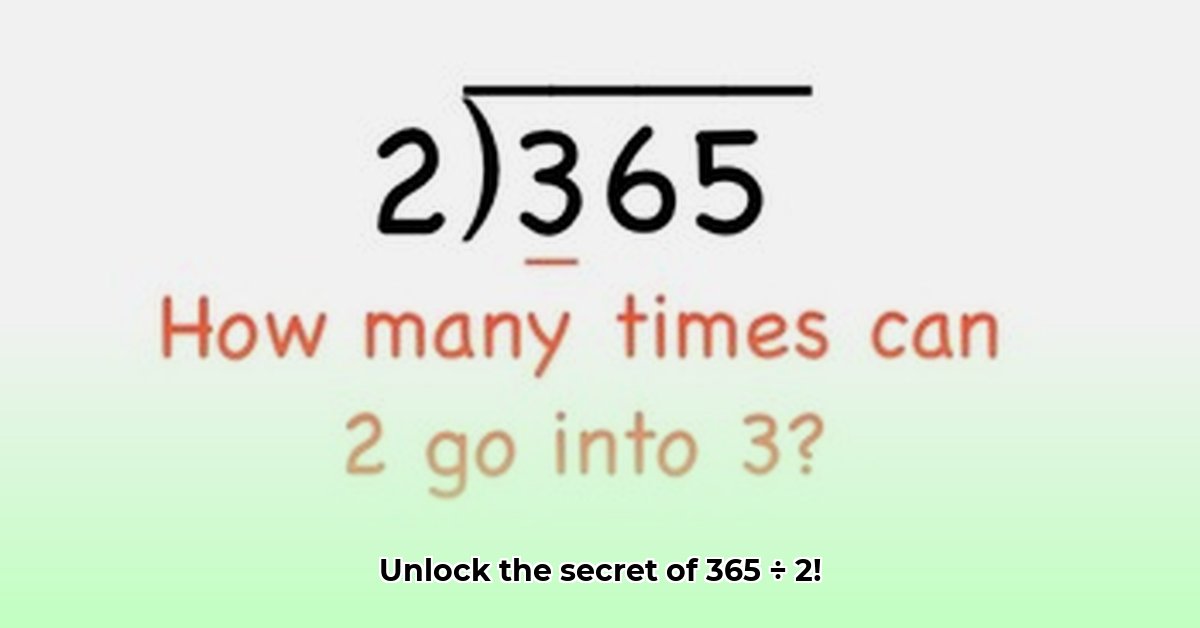
Let’s further break down the integer division process to solidify understanding. We'll use the long division method to calculate 365 ÷ 2.
Step 1: Set up the Long Division
Write 365 inside the long division symbol and 2 outside it.
Step 2: Divide the Hundreds
How many times does 2 go into 3? Once (2 x 1 = 2). Write down "1" above the 3. Subtract 2 from 3. The result is 1.
Step 3: Bring Down the Tens
Bring down the next digit (6). You now have 16.
Step 4: Divide the Tens
How many times does 2 go into 16? Eight times (2 x 8 = 16). Write down "8" above the 6. Subtract 16 from 16, the result is 0.
Step 5: Bring Down the Ones
Bring down the last digit (5).
Step 6: Divide the Ones
How many times does 2 go into 5? Twice (2 x 2 = 4). Write down "2" above the 5. Subtract 4 from 5. The remainder is 1.
Therefore, 365 ÷ 2 = 182 with a remainder of 1.
Beyond the Basics: The Significance of Remainders
Remainders provide valuable additional information. In our 365-day year example, the remainder of 1 in the integer division highlights that a half-year is not exactly 182 days. This understanding is important for precise calculations. Imagine planning a project; the remainder may show you need to adjust your schedule. Understanding the remainders empowers you to find more nuanced and detailed solutions.
“The ability to understand and utilize both integer and decimal division is a cornerstone of mathematical literacy,” says Dr. Evelyn Reed, Professor of Mathematics Education at the University of California, Berkeley. "It's not just about getting the right answer, but about choosing the right method to solve the problem."